
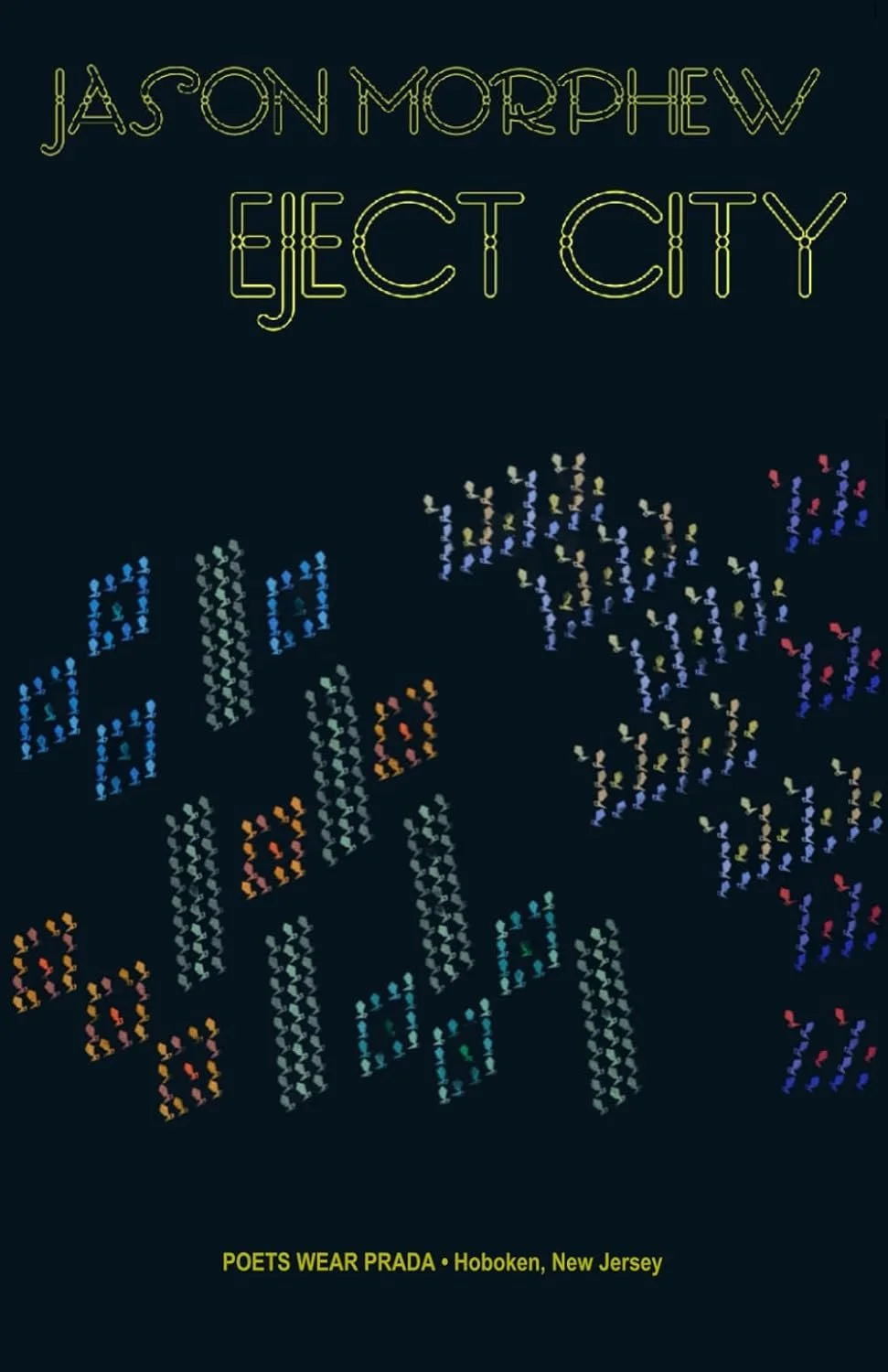
Eject City by Jason Morphew
(Poets Wear Prada)
“This is where I’ll journey/ to this thick luxury/ of skin and music/ my unearned authority”
As I write this it is the beginning of December and a season that, while joyous to so many, for others is a source of pain. My wife died from cancer this past July and I am currently trying to figure out how our family will celebrate the holidays deprived of her. It won’t be easy, I know that much. Occasions and relationships with family are often arduous struggles. This is something that Jason Morphew reminds us of in his book, Eject City.
Throughout the book Morphew confronts the past, however painful. Many of the poems are about the narrator’s relationship with his father, which can be described as problematic at best. “My dad/ extravagantly corn-syrupped/ was making animal/ noises and leaping” he writes in “Snow White Café.” The father represented in this collection is a hard man to love, deeply flawed in many ways. The poems are candid about this and I was relieved that there were no mawkish attempts at phony reconciliation. As heartbreaking as it is to read the words “years later my father died/ after not speaking to me again/ for years or knowing his grandchildren”, this is an acknowledgment of the estrangement that occurs in families. These relationships are complex, mysterious, and sometimes even disturbing. Morphew should be applauded for navigating the complex depths of family tension instead of seeking the easy answers that glimmer misleadingly on the surface.
While the book is concerned with the past, thankfully, it doesn’t allow us to remain there. Eject City is about generations, sons dealing with fathers but also sons/fathers raising children of their own. The collection is sprinkled with endearing anecdotes about fathering small children such as “my daughter cheating/ on a poster where/ you find hidden objects.” Lines like this help to alleviate the darkness and add a necessary balance. Obviously, parenting isn’t easy, “my daughter asked me how/ many cigarettes my father smoked/ in what for brevity’s sake we’ll unlaughingly proclaim/ his life” but in so many of these interactions we find reasons for hope in the future. And this kind of hope takes just as much bravery as a foray into the darkness of the past.
In addition to being a fine poet, Jason Morphew is also a musician. There are some great lines referencing music and popular culture in the book. “Keith Richards smoked his father/ mine smoked me” was one I enjoyed, and also “it takes a lot of flannel/ to survive the 80s” which might be the best opening to a poem I have read in a while. There is also a poem dedicated to “Ikey”, who was “always in a hundred bands/ always late for rehearsals” which is a situation that I am sure many of my musician friends can relate to. Beyond this, there is a superb musicality in Eject City. Morphew has a good ear for the rhythms of language, as evidenced here: “drowned pounded/ and surrounded/ by the future not/ having him with me.”
Many of these poems are localized in Southern California. Openings like “the bartender at Trunks/ in WeHo gave me/ a margarita removed/ his shirt” place us in the midst of an engaging scene. In this way the narrator becomes familiar to us, just another customer sitting a few seats away in a bar or restaurant. Another effective way Morphew does this is with humor. “Wanting to learn/ mountain climbing despite/ despising mountains/ and climbing” made me laugh mid-page. And perhaps this ability to laugh even during the hard times is the most important lesson to glean from this collection. Whatever we are going through, there is still a good laugh, a good drink, a good band, or a good book just over the horizon. Eject City is one such book.

Benjamin Schmitt
Benjamin Schmitt is the author of four books, most recently The Saints of Capitalism and Soundtrack to a Fleeting Masculinity. His poems have appeared or are forthcoming in Sojourners, Antioch Review, The Good Men Project, Hobart, Columbia Review, Spillway, and elsewhere. A co-founder of Pacifica Writers’ Workshop, he has also written articles for The Seattle Times and At The Inkwell. He lives in Seattle with his two children.